
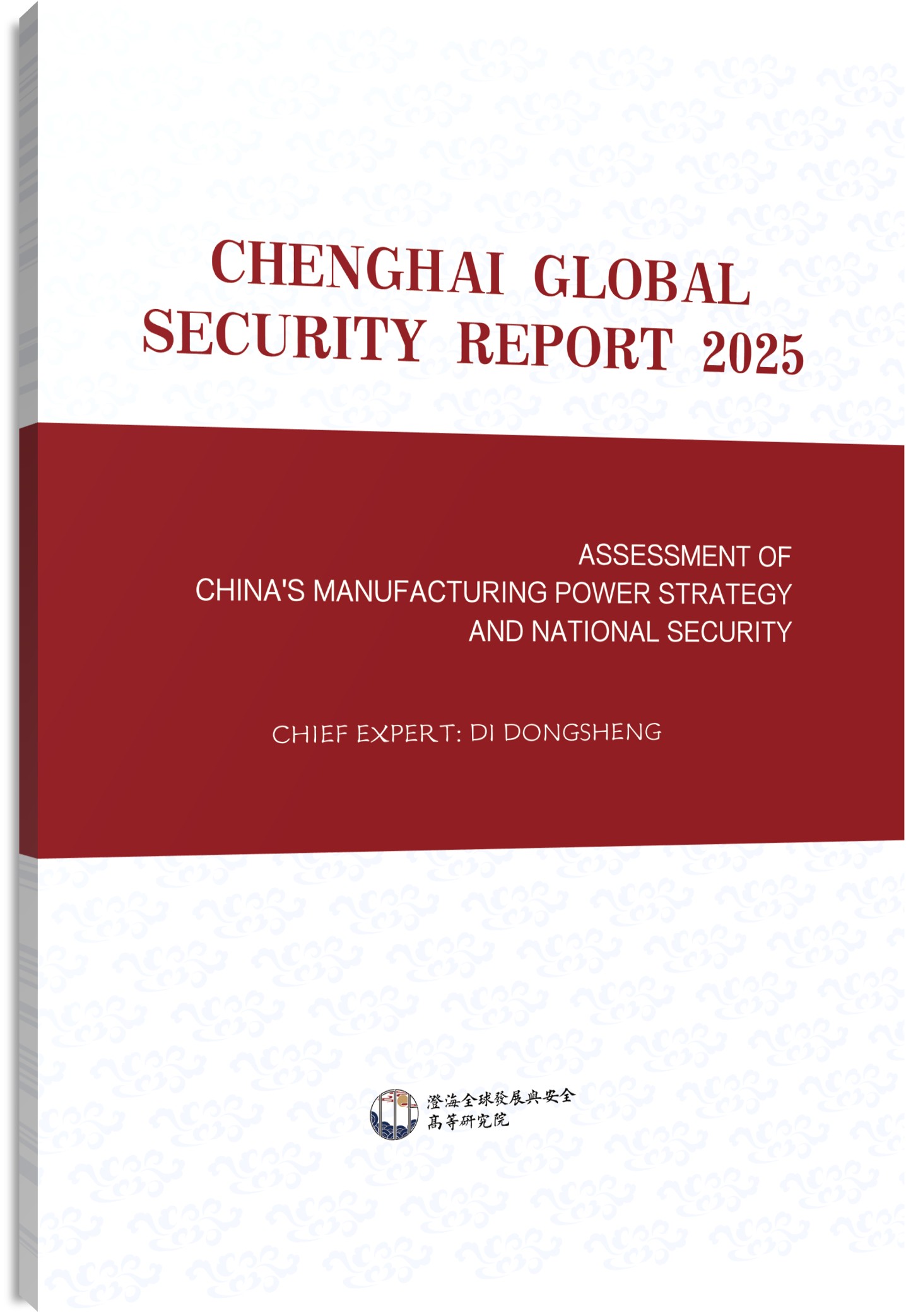
2025 marks the final year of the "Made in China 2025" initiative. Over the past decade, China's manufacturing industry has achieved technological breakthroughs in key fields such as semiconductors, new energy vehicles, large aircraft, unmanned aerial vehicles (UAVs), and industrial robots, providing solid material and technological support for national security. Meanwhile, the continuous upgrading of China's manufacturing industry has also aroused concerns among some Western countries about their own industrial security. However, such external pressure has further boosted China's independent innovation, and the foundation of national security has thus been continuously consolidated.
This report systematically interprets the dynamic correlation between "Made in China 2025" and national security from three theoretical perspectives: the "price revolution", the weaponized interdependence, and the security dilemma.
The "price revolution" serves as the core theoretical perspective, referring to the transformation where China, through independent research and development, drives industrial manufactured goods to achieve a substantial price reduction while improving their quality. This transformation is rooted in multiple factors such as the industrial cluster effect, improved and stable infrastructure, and the high overall quality of the workforce. At the domestic level, this transformation has enhanced national governance capacity, reduced the risk of China's manufacturing industry being "strangled by a shortage of key technologies", and effectively consolidated the foundation of national security. At the international level, it has provided affordable industrial manufactured goods for developing countries and strengthened their national security capabilities from five dimensions, namely productivity, transportation capacity, power supply capacity, computing capacity and firepower transformation. Nevertheless, it has also exacerbated the international security challenges confronting China.
Both the weaponized interdependence and the security dilemma focus on the changes in the international security situation triggered by China's drive to build itself into a manufacturing power. The former refers to the fact that the upgrading and leading position of China's manufacturing industry has reduced the risk of Western countries using interdependence as a "weapon" to suppress China. However, it has also made Western countries worry that China will "weaponize" their dependence on China, thus prompting them to tighten containment measures against China. The latter refers to the phenomenon that China's measures to strengthen its own security have aroused unease among Western countries, prompting them to introduce containment measures, which in turn has forced China to increase investment in independent innovation, further intensifying the sense of insecurity of Western countries.
To address potential security risks in the manufacturing sector, China launched the "Made in China 2025" strategy in 2015. At that time, on the one hand, China's manufacturing industry was highly dependent on Western countries including the United States in terms of core technologies, high-end talents, capital and consumer markets, suffering from the limitation of ''being large but not strong'' and facing the hidden danger of being "strangled by a shortage of key technologies" by Western countries. On the other hand, developed countries successively implemented re-industrialization strategies, while developing countries undertook labor-intensive industries by virtue of their cost advantages. As a result, China's manufacturing industry was confronted with the dual pressure of high-end industries flowing back to developed economies and low-end industries relocating to other developing countries.
Looking back over the past decade, the industrial development goals set by "Made in China 2025" have been basically achieved. Through the implementation of systematic measures—including five key projects, the formulation of four development plans and guidelines covering new materials, the pharmaceutical industry, the information industry and manufacturing talent cultivation, as well as the issuance of two special action guidelines on service-oriented manufacturing and quality and brand enhancement—"Made in China 2025" has successfully steered China's manufacturing sector into a new stage of high-quality development. High-end manufactured products have become the backbone of goods exports, and China has reached or approached the world's advanced level in a number of manufacturing fields.
Over the past decade, "Made in China 2025" has consolidated the foundation of national security across several domains: In terms of economic and technological security, China has broken through blockades on a number of key technologies. Western countries including the US have seen their dependence on China increase in certain fields, which has made them hesitant to act when imposing economic sanctions and trade embargoes against China. In terms of military and territorial security, the accelerated conversion of civilian technologies to the defense sector has led to substantial price reductions and rapid iterative upgrades of weaponry and equipment, fostering a comprehensive security protection system that covers land, sea, air and cyberspace. In terms of resource and ecological security, the upgrading of the manufacturing sector has not only driven the transformation of energy into industrial products, but also strongly boosted the circular economy, establishing a stable and sustainable green support system for resource and ecological security. In terms of food security, spanning from high-end agricultural machinery and water-saving irrigation, to salinealkali land improvement and intelligent warehousing, the manufacturing sector has provided full-chain, systematic and solid support for food security.
To counter China's "price revolution" in high-end manufacturing and curb the development of China's high and new technologies as well as its industrial transformation and upgrading, Western countries including the US have adopted a dual approach of supporting their domestic sectors and cracking down on China. However, these measures have forced China to boost independent innovation in such key fields as semiconductors and operating systems.
"Made in China 2025" has profoundly reshaped the global economic and trade landscape: China is advancing toward the core of the world market; the deindustrialization process in the US is irreversible, and the effects of manufacturing reshoring and "de-Chinaization" have been limited; the EU and Japan are caught in the dual squeeze from China and the US; developing countries have benefited from entrepôt trade and industrial undertaking amid the deepening China-US competition, as well as the inclusive economic globalization driven by the "price revolution".
At present, China's manufacturing sector stands at a critical juncture of upgrading and moving toward the global forefront. Manufacturing is highly intertwined with national security, and its development has become the core driver of high-quality economic growth and the safeguarding of national interests. Currently, the endeavor to build a strong manufacturing nation still faces challenges such as the imbalance between supply and demand structures, severe employment pressure, and the unresolved issue of being "strangled by a shortage of key technologies". It is recommended that China adhere to the principle of "independent control" in key fields during industrial upgrading and continuously consolidate the material and technological foundation of national security. In addition, the ultra-large-scale domestic market can not only stabilize economic growth but also effectively fend off external shocks. Therefore, it is imperative to unswervingly implement the strategy of expanding domestic demand, deepen reforms in income distribution and public finance, improve the social security system, optimize the consumption environment, and accelerate the fostering of a new development paradigm.