
Academic research is a "project of patience". Since the establishment of the Center for Historical Political Science at the School of International Studies, Renmin University of China in 2019, this series represents the first batch of achievements under the Series on the Autonomous Knowledge of Historical Political Science and Chinese Political Science. It aims to make a substantive contribution in terms of methodology to the construction of an autonomous knowledge system for Chinese political science.
To date, four volumes have been published in this series:
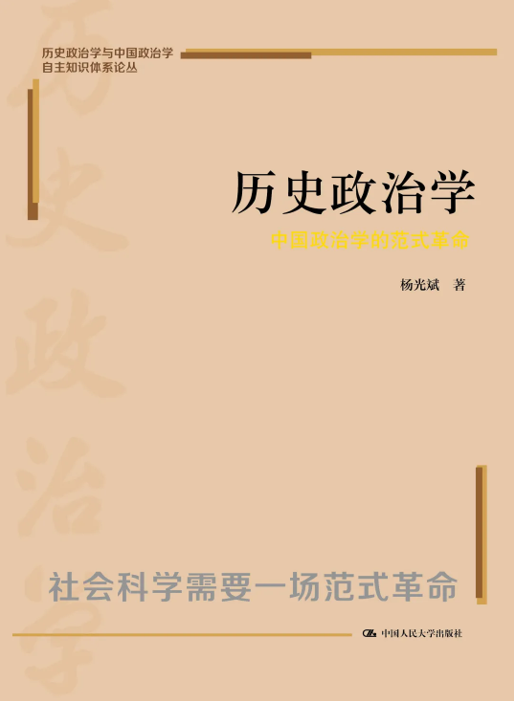
Historical Political Science: A Paradigm Revolution in Chinese Political Science
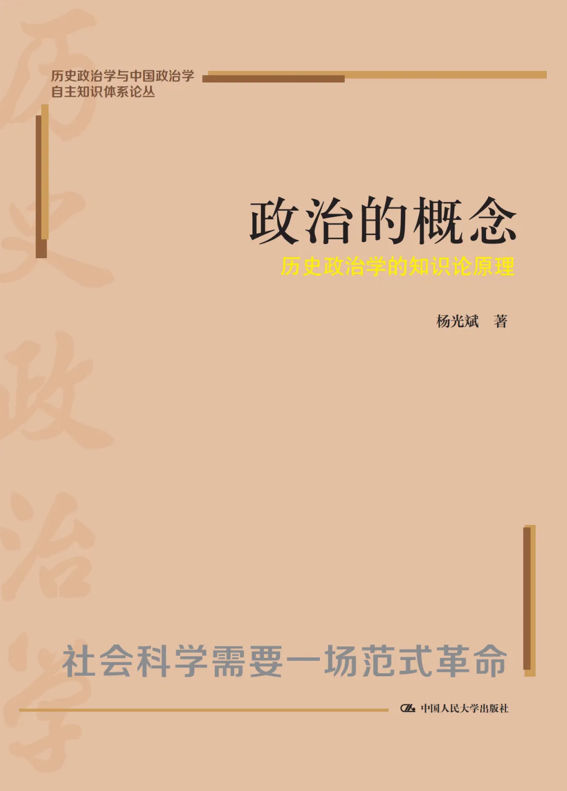
The Concept of Politics: The Epistemological Principles of Historical Political Science
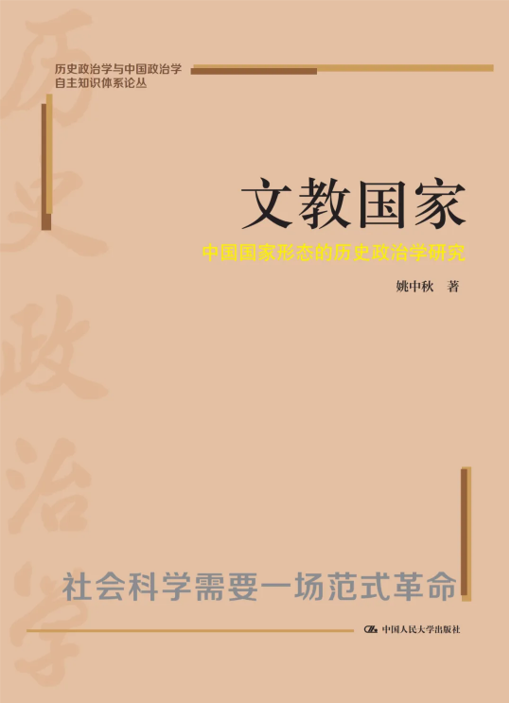
The Cultural-Educational State: A Historical-Political Study of China's State Form
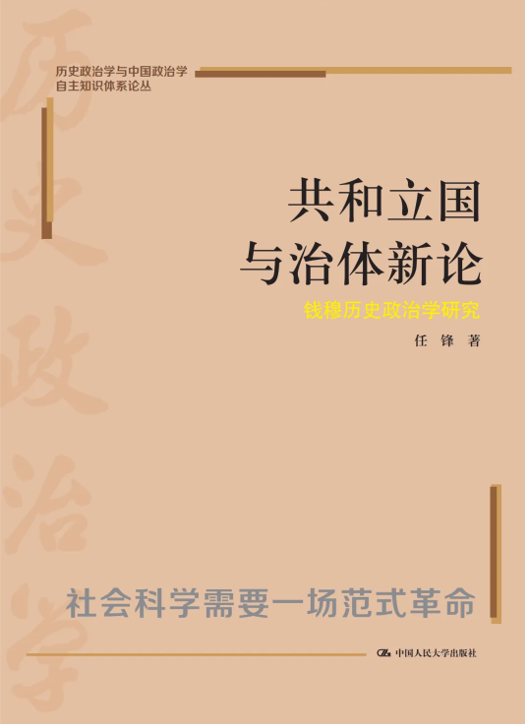
Republican State-Building and New Theory of Governance: A Study of Qian Mu's Historical Political Science
About the editor:
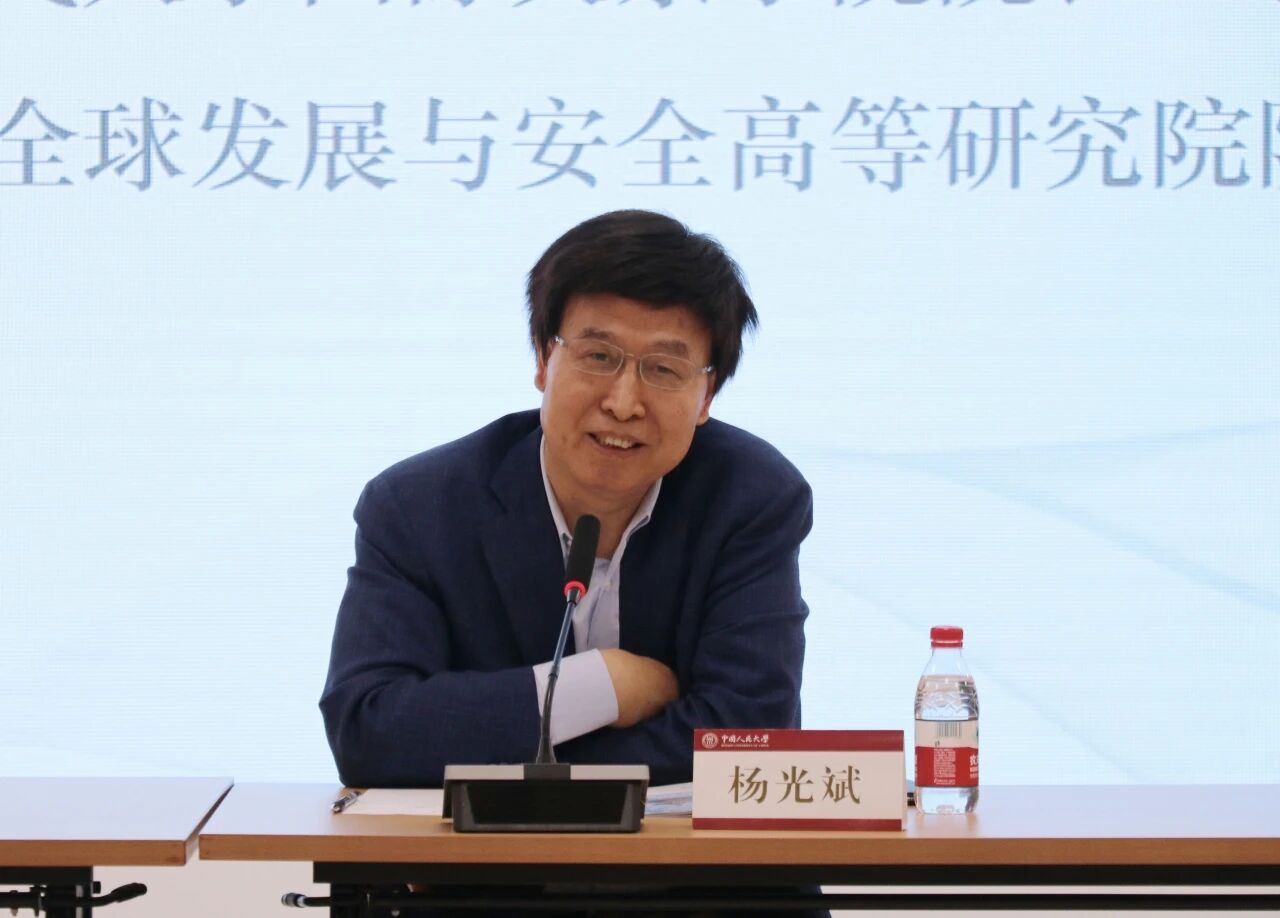
Yang Guangbin, Member of the 13th and 14th National Committees of the Chinese People's Political Consultative Conference (CPPCC), Dean and Professor of the School of International Studies at Renmin University of China, and Dean of the Chenghai Institute of Global Development and Security. He has been selected into the National High-Level Talent Program of the Ministry of Education. His research fields cover political science theories and methodologies, contemporary Chinese politics, and world politics. In recent years, he has devoted himself to advancing the studies of historical political science and world politics. His representative monographs include Historical Political Science: A Paradigm Revolution in Chinese Political Science, World Political Theory (winner of the 9th Higher Education Outstanding Research Achievement Award (Humanities and Social Sciences) by the Ministry of Education), Epistemology of Chinese Politics, and Ideal Democracy and Practical Democracy. His representative textbooks include Introduction to Political Science (revised to its 5th edition) and Introduction to Contemporary Chinese Political Institutions (2nd edition awarded the Second Prize of National Excellent Textbooks).
About the four volumes:
Historical Political Science: A Paradigm Revolution in Chinese Political Science by Yang Guangbin
The overarching nature of political science knowledge and its foundational status among the social sciences determine that the formation of an autonomous knowledge system in political science will surely consolidate the theoretical foundation of Chinese‑style modernization and boost the great rejuvenation of the Chinese nation. This book first briefly reviews the "volatility" of the history of Western political thought and its underlying causes. It then explains how Western political science, which justified the legitimacy of Western democratic regimes during the Cold War, evolved into a political science aimed at "transforming" other countries and created paradigms for such "transition." It further examines the gains and losses of Chinese political science, which has been "seeking change" over the past century. Finally, it summarizes the main orientations of Chinese political science research since the reform and opening‑up, namely that institutional research on state governance has become the mainstream of Chinese political science. China's achievements must be given a positive interpretation. A theory that cannot explain China's achievements cannot be regarded as a sound social science theory. Theories must directly confront the achievements based on China's historical culture and experience. These achievements must be elevated into concepts, theories, and even paradigms. Accordingly, social science is in need of a paradigm revolution, and historical political science has emerged as a response.
The Concept of Politics: The Epistemological Principles of Historical Political Science by Yang Guangbin
As a methodological approach in political science, historical political science has uncovered the mechanism underlying the emergence of political theory—namely, its epistemological principles. The historical nature determines the divergent patterns of institutional change, from which political theories of distinct natures arise. From a comparative historical perspective, a comparative study of the evolution of state forms, governmental systems, state–society relations, and foreign relations between Eastern and Western states reveals the following: In European social history, institutional change took the form of competitive and confrontational resource distribution, which correspondingly gave rise to confrontational political institutions and theories. In Chinese political history, the pattern of institutional change under unified governance has evolved into a political theory centered on governance competence and popular support. The concept of the political most fully embodies the differences in historical cognitive psychology and behavioral patterns. It thus opens the door to reinterpreting the theoretical systems and foundational concepts of the social sciences, providing an effective path for constructing an independent knowledge system of Chinese political science.
The Cultural-Educational State: A Historical-Political Study of China's State Form by Yao Zhongqiu
This book adopts the research approach of historical political science and conducts historical research with theoretical awareness. By analyzing the origin, evolution, structure, and operational logic of the cultural-educational state, it attempts to reconstruct political science theories, including state theory. The major arguments of this book are: Geographical conditions determine that China is a productive state; Cultural education and theistic religion constitute the two fundamental types of universal religions in human society; Cultural education performs the special function of cultivating and guiding theistic religions, shaping a composite religious system characterized by "one cultural-educational tradition, multiple theistic religions, with all theistic religions subordinate to cultural education"; Cultural education underpins the mechanism of political rule, giving rise to the cultural-educational state; Cultural education endows the family with an ontological status of existence, making the nation an affective political community; Cultural education fosters a life-enhancing principle and historical-political rationality, effectively safeguarding the great unification; Cultural education shapes the shi-ren and scholar-officials, forming an advanced leading group; Contemporary China is an enhanced version of the cultural-educational state, which is superior to Western nation-states and liberal states in both value and institutional dimensions.
Republican State-Building and New Theory of Governance: A Study of Qian Mu's Historical Political Science by Ren Feng
Based on an exhaustive study of Qian Mu's writings, this book offers an in-depth discussion of great unification, the relationship between politics and education, and historical political science. It argues that neither "returning to the past" nor "total Westernization" can serve as a practical foundation for modern state-building. Instead, the relationship between tradition and modernity, and between Chinese civilization and foreign civilizations, should be viewed within the overarching framework of a republican state. Revolution, war, and governance since the late Qing dynasty can only be properly understood from the perspective of the modern upgrading of great unification. It can be said that the new theory of governance has gained renewed vitality within the republican system by openly absorbing insights from both Chinese and Western traditions. In much the same way, the classics-and history-based statecraft scholarship represented by Qian Mu has evolved into a paradigmatic path for the modern renewal of Chinese tradition through dialogue with imported political science. The arguments in this book extend beyond the history of political thought, focusing instead on the new political science indicated by pioneering thinkers such as Qian Mu.
General Preface (excerpt) by Yang Guangbin
"Calling for Political Science Principles Based on China's History and Culture"
From ancient times to the present, every political regime has needed its own "political science principles" to elaborate on the rationality and legitimacy of its political rule. China's thousands of years of scholarship on classics and history served as its political science principles. After the New Culture Movement, this classics-and-history-based political science was replaced by Western political science—specifically, Western political science methodologies and historical perspectives rooted in Western history and culture were used to judge the right and wrong, good and bad of Chinese politics. Political science thus transformed from a role of political defense to that of a critic and even a revolutionary. From the late Qing Dynasty to before 1949, the prevalent methodology in Chinese political science was institutionalism originating from continental Europe. This is a European political science tradition dating back to ancient Greece, which inquires into what kind of political system is the best. After the widespread bourgeois revolutions in Europe in the 19th century, the tradition of political system theory evolved into institutionalism in terms of political science methodology. Behind the institutionalist methodology lies a historical view (or worldview) that emphasizes representative government as the best form of government—a methodology and worldview cherished by famous historian François Guizot and liberal master John Stuart Mill alike. Therefore, institutionalist methodology cannot be simply summarized by so-called drawbacks such as being static and legalistic. As a prevalent methodology, it actually popularizes a historical view, which is used to measure the quality of a country's politics. The tension between such a political science and Chinese politics at that time was self-evident.
In 1980, political science was re‑established in China, Marxist political science underwent systematic research, and the study of Chinese politics began to be explored. However, Chinese political science—along with the entire Chinese social sciences—had not yet built its own system of political science principles when it was suddenly confronted with American and Western political science, and thus came under profound influence. Methodologically, behavioralism and rational choice theory—dominant trends in post‑World War II American political science—prevailed. Rational choice theory, based on the maximization of individual interest, amounts to an academically paradigmatic packaging of the doctrine of individual supremacy. It is undoubtedly rooted in the culture of "natural individualism" in the United States. Fukuyama's "end of history" thesis is precisely the historical view expressed by rational choice theory: that the best and final form of government for the realization of individual values is American‑style representative democracy. Measuring Chinese politics against such a historical view has only intensified the tension between the discipline and politics.
The 120-odd-year journey of Chinese political science has not been smooth. On the one hand, China's traditional political thought is highly developed, and Marxism serves as the guiding ideology, yet their degree of disciplinary systematization urgently needs to be enhanced. On the other hand, Western political science, which has no ideological foundation in China, has a high level of disciplinary systematization and exerts a profound influence on the disciplinary system of Chinese political science. This contradiction has seriously restricted the development of Chinese political science and even the entire social sciences. Chinese-style modernization calls for the construction of an autonomous knowledge system of Chinese political science. The foundation of an autonomous knowledge system lies in methodology—just as institutionalism and rational choice theory gave birth to Western political science. All disciplines are striving to construct their own autonomous knowledge systems, but a crucial prerequisite is having a methodology exclusive to the discipline itself.