
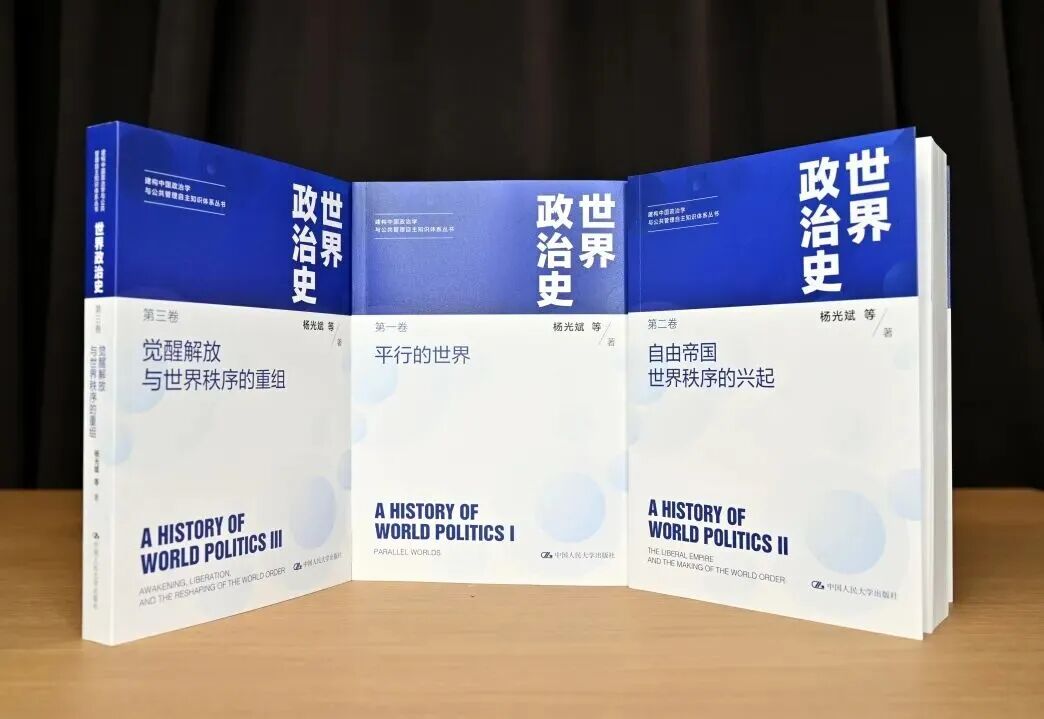
This book series endeavors to provide a "new historiography" for the study of international issues. The proposed "world politics" paradigm focuses on the institutional changes of states driven by the world market and political ideologies, as well as the world order shaped thereby. As a theory of world politics rooted in China's traditional political civilization, Marxist world history theory, and the practice of the Communist Party of China, it is of great significance for disenchanting Western-centric international relations studies and constructing an autonomous Chinese knowledge system in political science. Comprising three volumes and nineteen chapters, the book is structured as follows: Volume One mainly examines the diverse landscape of world order before the 16th century. Rejecting the narrow perspective of Eurocentrism, it places European civilization on an equal footing with Confucian, Indian, and Islamic civilizations, and analyzes how different civilizational forms constructed regional world orders. Volume Two spans the 16th century to the mid-20th century, recounting the rise of the Western world and the formation of the modern Western-dominated world order—a historical structure from which we have not yet emerged. Volume Three focuses on various "counter-movements" against the liberal imperial world order since the 20th century, including socialist movements, national liberation movements, and diverse forms of resistance within Western countries. The rejuvenation of China heralds the emergence of a new world order.
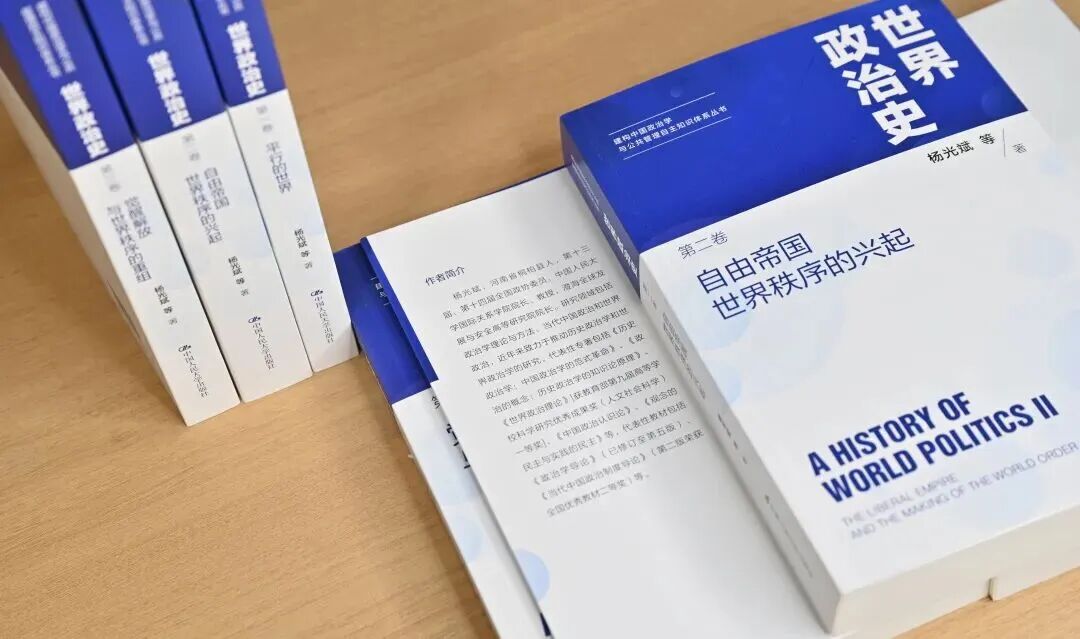
About the author:
Yang Guangbin, Member of the 13th and 14th National Committee of the Chinese People's Political Consultative Conference (CPPCC), Dean and Professor of the School of International Studies at Renmin University of China, and Director-general of the Chenghai Institute of Global Development and Security. His research interests cover political theory and methodology, contemporary Chinese politics, and world politics. In recent years, he has devoted himself to advancing the studies of historical political science and world politics. His representative monographs include Historical Political Science: A Paradigm Revolution in Chinese Political Science, The Concept of Politics: Epistemological Principles of Historical Political Science, World Political Theory (winner of the 9th Higher Education Outstanding Research Achievement Award (Humanities and Social Sciences) by the Ministry of Education), An Epistemological Approach to Chinese Politics, and Ideal Democracy and Practical Democracy. His representative textbooks include Introduction to Political Science (revised to its 5th edition) and Introduction to Contemporary Chinese Political Institutions (2nd edition awarded the Second Prize of National Excellent Textbooks).
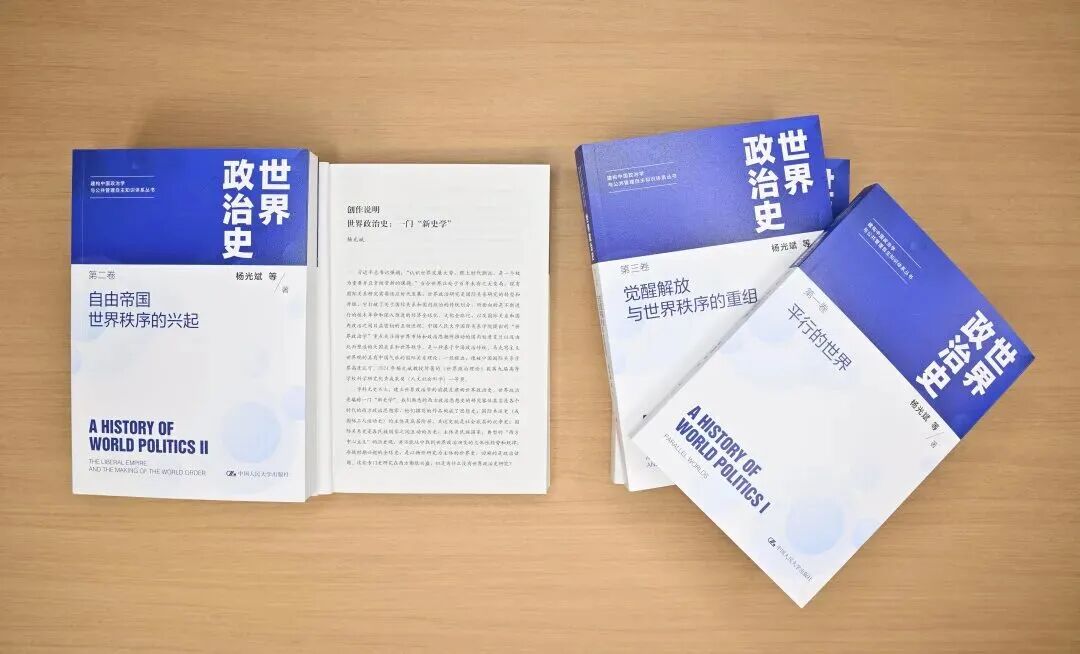
World Political History: A "New Historiography"
Yang Guangbin
President Xi Jinping emphasizes: "Understanding the overall trends of global development and keeping pace with the times is an extremely important task that remains ever-relevant and ever-new." The world today is undergoing momentous changes unseen in a century. Existing research on international relations must adapt to the progress of the times. The study of world politics represents a transformation and upgrading of international relations studies. It breaks through the traditional divide between international relations and domestic politics, addressing the ongoing technological revolution, the deepening advancement of economic and cultural globalization, and the increasingly close interaction between international relations and domestic politics.Proposed by the School of International Studies at Renmin University of China, "world politics" focuses on domestic institutional changes driven by the global market and political ideologies, as well as the major-power relations and world order shaped by these changes. It is a distinctly Chinese international relations theory rooted in China's political traditions and Marxist worldview. Since its introduction, it has been highly recognized within the Chinese academic community of international relations.
No discipline can stand without history. The prerequisite for establishing world politics is to construct a world political history. World political history can be regarded as a "new historiography".The subject of the familiar Western history of political thought is in fact Western political thinkers of various eras, whose works constitute the history of thought. The history of the international communist movement (or the international workers' movement) centers on the grassroots classes, and is thus a history of struggles by the lower classes. The history of international relations is a history of interactions among nation-states, with nation-states as its main actors. Characterized by a typical Eurocentric view of history, it fails to reveal the overall trends and laws governing the evolution of world politics. Global history, which emerged during the Cold War, is a world history centered on the study of objects and avoids political themes. These specialized histories thrive in the West, so why is there no study of world political history?
The actors of world politics certainly include individual states and international non-governmental organizations in the sense of international relations studies. However, the most important actors are "state blocs" formed on the basis of geography, the world market, or political ideas, such as the "great powers". There are multiple dimensions for classifying "state blocs": In terms of temporal relations, state blocs can be divided into early developed countries and developing countries (or the Global South); From a geographical perspective, they can be categorized as Western countries and Eastern countries; According to the form of ownership of the means of production, they can be divided into capitalist countries and socialist countries; and so on. By taking "state blocs" as the political actors of world history, we can better grasp the trajectory of the evolution of international relations and world politics from a macro-historical perspective.
It is not difficult to understand that a world political history centered on "state blocs" is in effect a bloodstained world history: one marked by wars among the early developed countries themselves, as well as wars of conquest, economic plunder, and political and civilizational colonialism waged by parts of this early developed bloc—the Western powers—against non-Western countries. This explains why Western academia is unwilling or even afraid to study "political history" and has instead turned to researching the history of political objects, the so-called "global history". However, as a major non-Western country, China has the responsibility to clarify the origins, set the record straight, and restore the truth of modern world history.
We believe that world political history is of great significance for establishing world politics, disenchanting Western-centric international relations studies, and constructing an independent Chinese knowledge system in political science.
Of course, we are well aware that, as an ambitious "new historiography" with a comprehensive framework, the system itself is open to discussion. Moreover, the more ambitious a research framework is, the more prone it is to flaws. Nevertheless, none of this should deter us from exploring this new historiography. Without new exploration, there can be no "zero-to-one" breakthroughs, and knowledge and thinking will remain confined to existing "information cocoons". Mistakes may be made in the course of exploration, yet it is worthwhile so long as we develop an original perspective that offers substantive insights into world politics. As a wise scholar once observed, the highest criterion for judging the quality of social science research lies in whether it provides meaningful enlightenment for understanding the social structures in which we live and which largely shape the course of our lives. We are convinced that this new historiography possesses such value of substantive enlightenment.
This research is a product of collective collaboration. Professor Yang Guangbin provided the ideas and framework for this study, and Associate Professor Shi Qipeng edited and finalized the entire manuscript. The specific division of labor is as follows:
Introduction, Sections 1, 3 and 4: Professor Yang Guangbin
Introduction, Section 2: Associate Professor Shi Qipeng
Chapter 1: Professor Yao Zhongqiu
Chapter 2: Associate Professor Cao Dejun
Chapter 3: Professor Tian Wenlin
Chapter 4: Associate Professor Wang Zhaodong
Chapter 5: Professor Yao Zhongqiu
Chapters 6 and 7: Dr. Wu Di
Chapter 8: Associate Professor Ding Fan
Chapter 9: Associate Professor Huang Chen, Huang Tingting, Sha Fan
Chapter 10: Associate Professor Shi Qipeng
Chapter 11: Professor Zuo Xiying
Chapter 12: Professor Song Wei
Chapter 13: Professor Yang Guangbin, Wan Zeyu
Chapter 14: Professor Pu Guoliang
Chapter 15: Associate Professor Huang Fei
Chapter 16: Associate Professor Shi Qipeng
Chapter 17: Professor Zhang Guangsheng, Professor Zhang Feian
Chapter 18: Professor Zhang Feian
Chapter 19: Professor Yang Guangbin
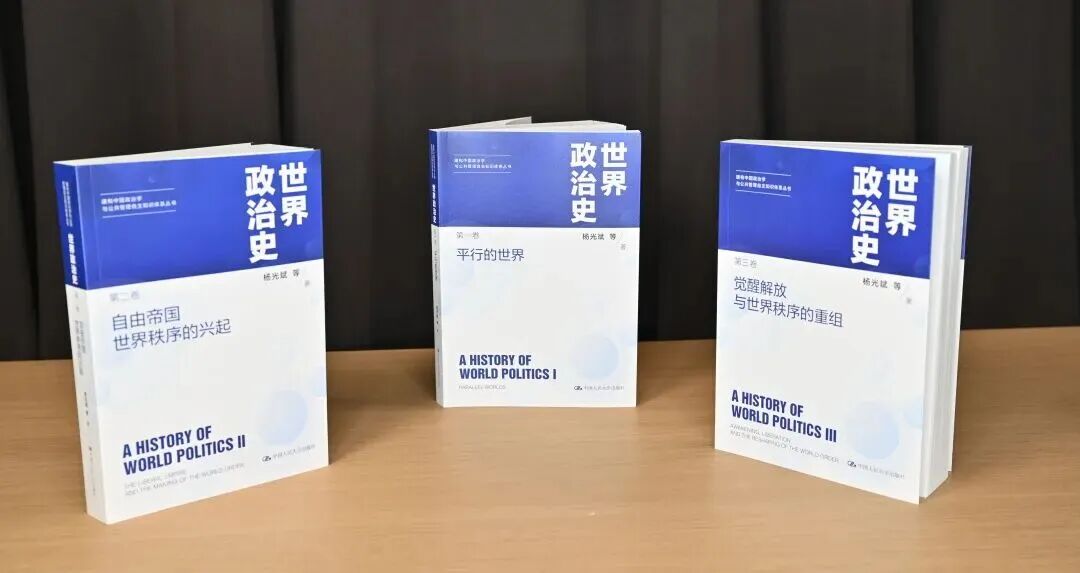
Volume One: Parallel Worlds
General Introduction Academic Agenda, Research Units and Analytical Methods
Section 1 World Political History as a "New Historiography"
Section 2 Research Unit I of World Political History: The World Market
Section 3 Research Unit II of World Political History: Political Ideologies
Section 4 Research Methods: Historical Political Science and the World Political System
Section 5 Chapter Arrangement
Chapter 1 The Formation of the Cultural-Educational State and the East Asian Tianxia Order
Section 1 The Early "Religious Revolution" and the Consolidation of Chinese Politics
Section 2 The Cultural-Educational State of Direct Rule: Structure and Operation
Section 3 Confucianization in East Asia and State Development
Chapter 2 Indian Civilization and the South Asian Regional Order
Section 1 Origins of Early Indian Civilization
Section 2 Foundational Ideas: From the Vedic Period to the Era of Mahajanapadas
Section 3 Ideological Divides: The Competition between Buddhism and Islam
Section 4 Diffusion and Clash of Diverse Intellectual Currents
Chapter 3 Islamic Civilization and the Greater Middle East Order
Section 1 The Birth of Islam and the Emergence of the Islamic World System
Section 2 Operational Mechanisms and Potential Problems of the Islamic World System
Section 3 Penetration of the Western System and the Disintegration and Reshaping of the Islamic World System
Section 4 Self-Redemption of Islamists and the Turmoil in the Middle East
Chapter 4 Medieval European Civilization and the Early Western Order
Section 1 The Origins of European Civilization
Section 2 Religious Theocracy and Secular Royal Power
Section 3 Monarchical Power and the Aristocratic Right of Resistance
Section 4 Dynastic Wars and Clashes of Civilizations
Section 5 Characteristics of Medieval Western Europe and European Civilization
Chapter 5 World Politics in the Midst of Civilizational Change
Section 1 The Origins of Civilizations and Their Formation in the Axial Age
Section 2 The Medieval Era: Theocratic-Secular Mechanisms in the Civilization of Barbarian Peoples
Section 3 The Early Modern Period: The Formation of the World Political Structure
Volume Two: The Liberal Empire and the Making of the World Order
Chapter 6 The Formation of European Nation-States
Section 1 The Political Structure of Medieval Western Europe
Section 2 The Impact of the Renaissance and the Reformation on Religious Authority
Section 3 Warfare, the Military Revolution, and the Growth of State Power
Section 4 The Formation of the Nation-State
Chapter 7 The Rise of European Capitalism
Section 1 State Power Behind the Rise of Capitalism
Section 2 The Dutch Merchant Republic and Capitalism
Section 3 The English State and Capitalism
Section 4 French Absolutism and the Development of Capitalism
Chapter 8 The Order Idea of Capitalism: Liberalism
Section 1 The English Revolution and the "Foundation" of Liberalism
Section 2 The Founding of the United States and "Liberty"
Section 3 The French Revolution and the 19th Century
Section 4 The Divided and Chaotic 20th Century
Chapter 9 The Dual Revolutions: The Political and Economic Foundations of the Rise of Liberalism
Section 1 Clarification of Key Concepts
Section 2 The Industrial Revolution: From Technology to Organization
Section 3 The Political Revolution: From Gradualism to Radicalism
Section 4 Liberalism: From Ideas to Ideological Trends
Chapter 10 The Global Expansion of the Western World
Section 1 Understanding Colonialism and Imperialism
Section 2 Colonial Expansion and the Dawn of the World Political System
Section 3 The Rise of Liberal Imperialism
Section 4 Imperialism and the Formation of the World Order
Chapter 11 Competition and Conflict Among the Western Powers
Section 1 The Theoretical Spectrum of Understanding Hegemonic Rivalry
Section 2 Overseas Expansion and Power Struggle Among the Great Powers
Section 3 Nationalism, Industrialization, and Total War
Section 4 Anglo-American Power Transition and the Transformation of the World Order
Chapter 12 Constructing World Order: Liberal Internationalism and Its Limits
Section 1 Liberal Internationalism and U.S. National Interests
Section 2 Liberal Internationalism and the Construction of U.S. Hegemonic Order
Section 3 The Postwar Political Order: Liberal Internationalism and Its Limits
Section 4 The Postwar Economic Order: Liberal Internationalism and Its Limits
Chapter 13 Theories of Western Domination over the World
Section 1 The Theory of White Supremacy
Section 2 The Theory of Cultural Superiority
Section 3 The Theory of Institutional Superiority
Volume Three: Awakening, Liberation, and the Reshaping of the World Order
Chapter 14 The Rise and Spread of Socialist Thought
Section 1 The Birth of Socialist Thought and the Development of Utopian Socialism
Section 2 The Emergence of Socialist Ideological Trends and the Rise of the International Communist Movement
Section 3 The International Spread of Scientific Socialism and the Vigorous Development of the Socialist Movement
Section 4 The Eastward Shift of the Center of the International Communist Movement
Section 5 Scientific Socialism Taking Root in the Fertile Soil of China
Chapter 15 Ideas and Practices of the Socialist World Order
Section 1 The Division of Socialist Thought and the Eastern Turn of Revolution
Section 2 The Formation of the Socialist System and the Establishment of an Anti-Capitalist Governance System
Section 3 The Disintegration of the Socialist Camp and the Rise of Socialism with Chinese Characteristics
Chapter 16 Nationalism, Liberation Politics and the Emergence of New States
Section 1 The Historical Origins of Nationalism
Section 2 National Liberation Movements in Latin America
Section 3 National Liberation Movements in Asia
Section 4 National Liberation Movements in Africa
Section 5 Grand Visions and Developmental Illusions
Chapter 17 Ideological Wars and Post-World Anti-Systemic Movements
Section 1 Anti-Communism and Internal Coordination in the Western World in the Early Post-War Period
Section 2 The Expansion of Anti-Systemic Movements Within U.S. Imperialism
Section 3 The Cultural Revolution of the "New Left" and Anti-Systemic Movements in Western Societies
Chapter 18 Waves of Democratization and Their Consequences
Section 1 The Cold War and the U.S. Reconstruction of Democratic Discourse
Section 2 Democratic Liberalization and the Third Wave of Democratization
Section 3 Identity Politics and the Crisis of Liberal Democracy
Section 4 The Crisis of Liberal Democracy and the Future of Democratic Politics
Chapter 19 The Great Global Transformation and Chinese-Style Modernization
Section 1 The Path of Chinese-Style Modernization in a Comparative Historical Perspective
Section 2 The Institutional Model Centered on the Democratic Centralist Polity
Section 3 The Development Model of "Upholding the Right Direction and Prioritizing Hybridity"
Section 4 China's Governance and the Great Transformation of the World Order