
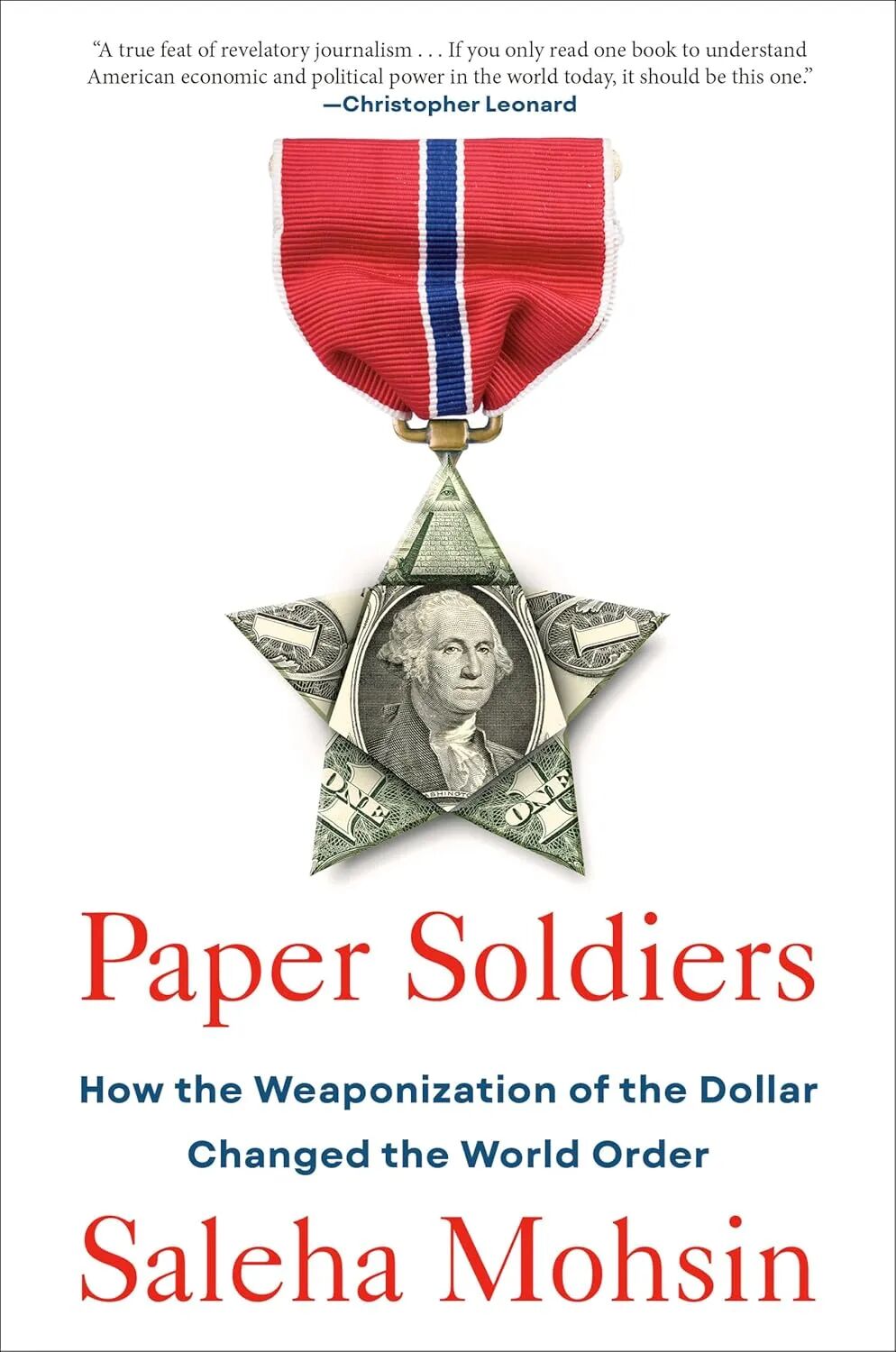
Starting from the postwar Bretton Woods system, this book traces the historical evolution of the U.S. dollar's dominant position, with a focused analysis of the growing prominence of financial sanctions in contemporary international politics after the 9/11 attacks. The author argues that the U.S. Department of the Treasury has transformed from a traditional economic management agency into a key actor in the national security apparatus. By controlling global financial infrastructure—including payment systems, U.S. dollar clearing mechanisms, and access to capital markets—it exerts influence over both allies and adversaries. Through detailed examinations of specific cases such as the sanctions on Iran and Russia, as well as the response to the 2008 global financial crisis, Mohsin reveals how financial power operates in practice as an alternative tool to military means. Theoretically, the central thesis of the book is that the "weaponization" of the U.S. dollar signals the emergence of a new form of statecraft. On the one hand, this model enables the United States to project power globally at relatively low cost; on the other, it poses potential long-term risks to the stability of the international monetary system. As more countries seek to reduce their reliance on the dollar-based system, the sustainability of U.S. financial hegemony—and the liberal international order built upon it—faces mounting challenges. Mohsin concludes that the weaponization of the dollar is likely a double-edged sword, which will ultimately erode its global dominance, driven more by America’s own policy choices than by the actions of its rivals.
Content:
Surviving Donald Trump
The Birth of Hegemony
Control Freaks and Vigilantes
Bob Rubin's Bumper Sticker
The Bad Dollar
A War Office for Treasury
The Crystal Ball ofTerror
A Secretary's Down fall, in Two Acts
"Just Call Me Hank"
Chicken Feet in Ohio and China's 1000 Year Horizon
Tim's Cash Room Crash
Need Warriors at Work
A Turbulent Marriage
A Treasury Heirloom Shattered
Mnuchin, the Oligarch, and Jack Lew's Nightmare
The Secret Dinner, and An Economic Blitzkrieg
About the Author:
Saleha Mohsin is a veteran American financial journalist and author who has long focused on U.S. macroeconomic policy and the operation of the fiscal system. She currently serves as a senior Washington correspondent for Bloomberg News, where she primarily covers the U.S. Department of the Treasury, the Federal Reserve, and economic policymaking processes in Washington. Drawing on extensive on-the-ground reporting experience and wide-ranging policy connections, Mohsin has developed a distinctive perspective on the U.S. dollar system, international financial sanctions, and global economic governance. Her representative work, Paper Soldiers: How the Weaponization of the Dollar Changed the World Order, draws on extensive exclusive interviews and insider details to systematically examine how the United States has transformed the dollar from a global reserve currency into a geopolitical instrument. Her writing blends journalistic narrative with policy analysis: it not only reconstructs key decision-making scenes but also probes deeply into the interplay between financial power and national strategy. As one of the few journalists who have long tracked the operations of the U.S. Treasury, Mohsin's research provides valuable insights for understanding the contemporary international political and economic order.
Book Review:
This book takes Paper Soldiers as its central metaphor, aiming to reveal a form of power distinct from traditional military force: the U.S. dollar is no longer merely a medium of exchange, but an "immaterial military force" that can be deployed, maneuvered, and deployed to achieve strategic effects. The validity of this metaphor first rests on the institutional construction of dollar hegemony. The book begins with a systematic review of the formation of the post-WWII international monetary system. The author argues that since the Bretton Woods Conference established the central role of the U.S. dollar, the United States has gradually built a global monetary system underpinned by state capacity, supported by financial markets, and bound by institutional trust. Unlike conventional interpretations in international political economy that emphasize Hegemonic Stability Theory or Public Goods Provision, this book highlights that the emergence of the dollar system exhibits a strong characteristic of Path Dependence.
Specifically, the dominant position of the U.S. dollar was not achieved overnight, but gradually consolidated through long-term institutional evolution. On the one hand, through capital market openness and financial liberalization, the United States has made the U.S. dollar the core medium for cross-border capital flows. On the other hand, the U.S. government has embedded global financial transactions into the dollar-centered clearing network via its legal and regulatory systems. Such institutional embeddedness has made the U.S. dollar not only a transaction instrument but also infrastructure for the functioning of the global economy.
In addition, the book places special emphasis on the critical role of trust. The U.S. dollar has been able to maintain its hegemony not only because of the enormous size of the U.S. economy, but also because its political institutions, rule of law, and financial transparency provide stable expectations for global investors. This institutional trust forms the hidden foundation of dollar power and also provides a prerequisite for the subsequent use of financial sanctions as a tool. Thus, the implicit theoretical proposition of the book is: the essence of monetary power lies in the degree of its institutional embeddedness; and the deeper the embeddedness, the greater its potential to be "weaponized".
Through the concept of the "Bad Dollar," the author reveals the distributional effects of dollar hegemony: on the one hand, global capital benefits from the dollar system; on the other hand, certain domestic groups bear the negative shocks brought about by globalization. This contradiction has gradually turned into a political backlash in subsequent policy practice, challenging the traditional consensus on dollar policy, particularly amid the rise of populism.
The book emphasizes that the effectiveness of the sanctions regime relies on international coordination and market compliance. To avoid risks, banks and corporations often proactively implement U.S. sanctions policies, creating a governance model in which the private sector enforces state policy. This mechanism enables the United States to impose enforceable economic policies globally, marking the transformation of the U.S. dollar from a "neutral currency" into an "instrument of power." In effect, the book reveals a new form of warfare: invisible warfare mediated through finance.
During the presidency of Donald Trump, the weaponization of the U.S. dollar entered a new phase. As the book points out, sanctions tools were employed more frequently and extensively in geopolitical competition, with Treasury Secretary Steven Mnuchin playing a pivotal role.
As these "paper soldiers" are deployed frequently, they are also depleting their own "trust capital." This stage thus reveals a paradox: the more the dollar is used as a weapon, the more its character as a global public good is eroded.
Against the backdrop of the Russia-Ukraine conflict, the United States and its allies imposed unprecedented financial sanctions, including the freezing of foreign exchange reserves and exclusion from financial networks. This economic blitzkrieg demonstrated the full power of the U.S. dollar system, yet it may also mark a turning point. Some countries have begun to explore pathways toward de-dollarization, but the U.S. dollar remains dominant due to the lack of viable alternative systems.
Through the metaphor of "Paper Soldiers", this book reveals the evolution of the U.S. dollar from a currency to an instrument of power. Its core logic is as follows: the institutional embeddedness of the financial system enables currency to function similarly to military force, yet such power is simultaneously constrained by trust and institutional legitimacy. The U.S. dollar serves as both a global public good and a tool of national power, and the way it is employed directly shapes the stability of the international order. This implies that the weaponization of the dollar is likely a double‑edged sword, which may ultimately erode its global dominance—a process driven far more by its own policy choices than by the actions of its rivals.